Haunted by Hoover, Trump Presses for an Iran Endgame as Hormuz Talks Drag On
The president has twice invoked Herbert Hoover while describing his push to end the Iran war, even as a June cease-fire deal has only partly held and negotiators haggle over terms for reopening the Strait of Hormuz.
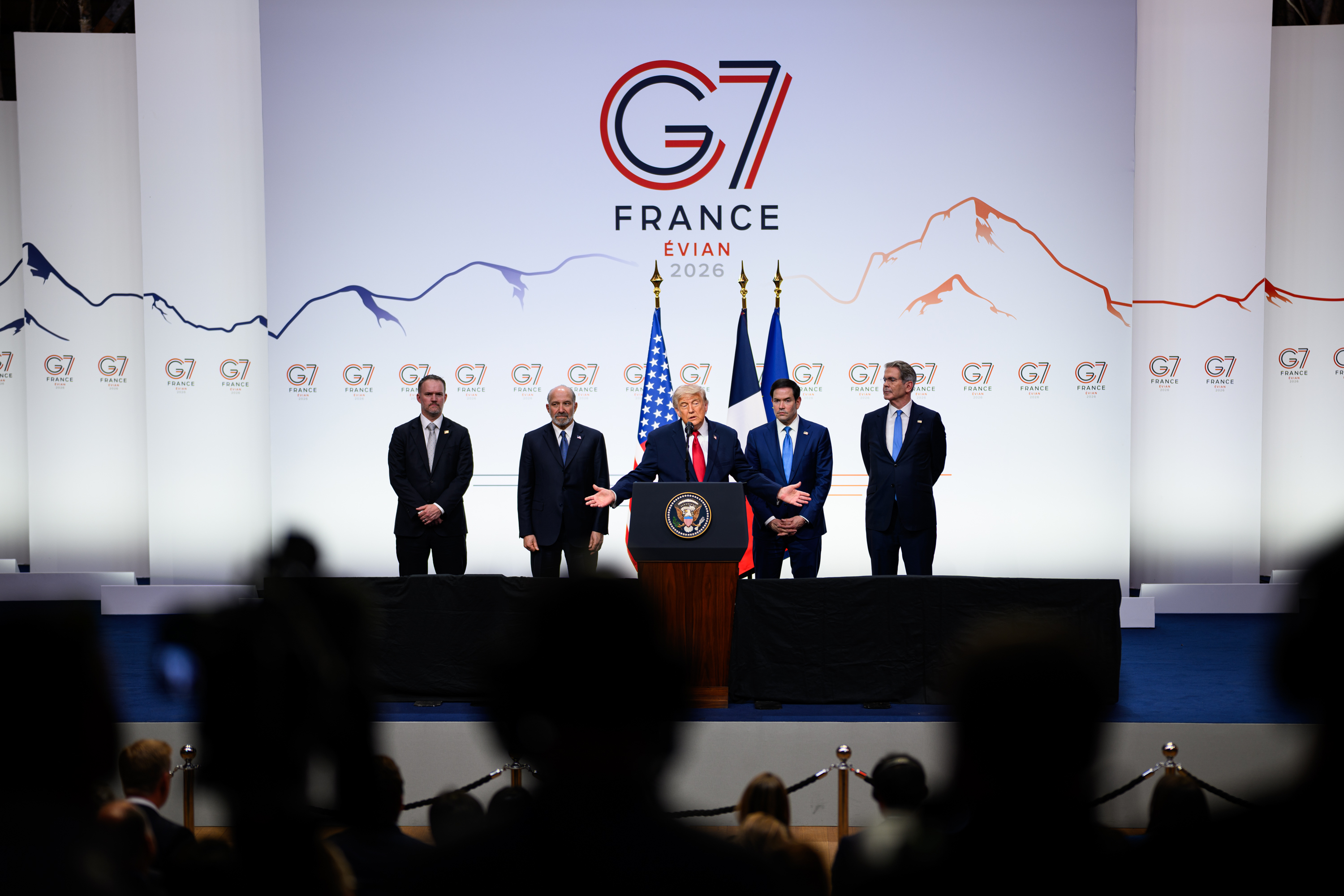
At a closing press conference of the G7 summit in Evian-les-Bains, France, on June 17, President Trump twice raised the name of Herbert Hoover while describing his push to end the war with Iran, according to a transcript of the remarks. "I've studied presidents, some good, some bad, some great. Not too many are great and some really bad. The one president I did not want to be was the late, great Herbert Hoover," Trump said. Later in the same appearance, discussing the economic stakes of the war, he added: "the one I always thought of, Herbert Hoover, and he caused it. He raised taxes too fast and he raised interest rates."
Hoover, a Republican who left office in 1933, is widely associated with the onset of the Great Depression. Trump told reporters that market reaction had reinforced his thinking on the war: "every time we talked about the possibility of peace, the stock market shot up like a rocket ship," he said, according to the same transcript.
That same day, Trump announced a preliminary Memorandum of Understanding with Iran to end the fighting. The White House, in a June 19 release titled "President Trump's Iran Agreement Is America First in Action," described the deal as ensuring "Iran will never obtain a nuclear weapon," reopening the Strait of Hormuz "to free navigation," and requiring no direct U.S. financial payments to Iran. At the press conference, Trump said of the agreement's nuclear terms: "Iran cannot have a nuclear weapon. They can't develop it, buy it, they can never have a nuclear weapon," and said of the strait: "Maritime traffic through the Strait of Hormuz has already increased very substantially."
The war did not end that week. The Pentagon later opened a new casualty-tracking category, "Overseas Operations," dating to July 7, 2026, when the Trump administration told Congress renewed military operations against Iran had begun, triggering a new 60-day window under the War Powers Resolution. Four U.S. service members killed in Jordan and Iraq in mid-to-late July were initially logged in the Iran war casualty count before being reclassified into the new category days later, according to a letter from House Oversight Committee Democrats to the Defense Department. Reps. Robert Garcia, D-Calif., and Suhas Subramanyam, D-Va., the panel's ranking Democrats, requested full records of the reclassification by Aug. 18 and said in a statement: "The Pentagon appears to be lying about casualties of fallen soldiers to continue justifying Donald Trump's war of choice with Iran." The Defense Department declined to comment on the letter. The Pentagon's official casualty count, tracked in its Defense Casualty Analysis System since the war began Feb. 28, has listed 18 U.S. troops killed and 687 wounded as of early August, spanning both the original Operation Epic Fury designation and the new Overseas Operations category.
In early August, Trump said he had agreed to call off a planned attack on Iran, citing requests from regional governments to de-escalate. "I have agreed...to cancel the attack, subject to being able to rapidly make a DEAL," he said. Iranian officials denied requesting any pause, with one calling the claim "nothing but a new lie." Since then, talks have narrowed to a specific, interim question: how to reopen the Strait of Hormuz, which Iran has restricted since the war began. Iran and Oman have discussed a 60-day trial arrangement in which inbound ships would use a northern shipping lane through Iranian waters and outbound ships a southern lane through Omani waters, with no transit fees during the trial period, according to Al Jazeera's reporting on the talks. Iranian Foreign Ministry spokesman Esmaeil Baghaei said the talks were focused on "establishing safe inbound and outbound shipping lanes" while upholding Iran's rights as a coastal state. Trump, addressing Iran's interest in eventually charging transit fees, said: "I'm not going to let them charge. Anybody's going to charge, we'll charge." Unresolved issues include long-term administration of the waterway, whether Iran may eventually impose service fees, and U.S. sanctions that complicate coordination with Iranian authorities. Iranian officials have separately accused the administration of "theater diplomacy" amid conflicting public statements about whether direct U.S.-Iran talks were taking place; Vice President JD Vance said the negotiations would "be messy" and take time.
Presidential historian Tevi Troy, a former White House aide to George W. Bush, said Trump's repeated Hoover references were characteristic. "Trump often reveals what he's thinking with these comments he makes... they're indicative of his upbringing," Troy said, adding: "Any Republican president who gets hit with bad economic times faces the danger of being tagged as Herbert Hoover." Bush invoked the same comparison during the 2008 financial crisis, telling congressional leaders, "We're going to act. I'm not going to be Herbert Hoover." Diane Swonk, chief economist at KPMG, has cautioned that the current economy differs substantially from the one Hoover presided over, saying policymakers now have tools to head off a Depression-scale collapse that did not exist in the early 1930s.
Sources
- https://www.whitehouse.gov/gallery/president-trump-at-the-g7-summit-in-france/
- https://www.whitehouse.gov/releases/2026/06/president-trumps-iran-agreement-is-america-first-in-action/
- https://rollcall.com/factbase/trump/transcript/donald-trump-press-conference-g7-summit-evian-france-june-17-2026/
- https://dcas.dmdc.osd.mil/dcas/conflictCasualties/oefu
- https://www.armytimes.com/news/pentagon-congress/2026/08/04/house-oversight-democrats-seek-records-behind-pentagon-changes-to-iran-war-casualty-database/
- https://www.aljazeera.com/news/2026/8/5/iran-oman-us-close-to-hormuz-deal-what-do-they-all-want
- https://www.npr.org/2026/08/09/nx-s1-5925960/trump-hoover-iran